Missouri Legislators Explore Early Childhood, Teacher Workforce, and AI at 2025 Education Policy Retreat
January 5, 2026
31 lawmakers meet with The Hunt Institute bipartisan policy retreat to discuss early childhood systems, the educator pipeline, artificial intelligence in classrooms, and workforce pathways.
What does Missouri need most to prepare students for the future? According to 31 state legislators who gathered in Columbia this October, the answer starts earlier, and requires more collaboration, than many might expect.
Lawmakers from both chambers and both parties convened on October 14–15 for The Hunt Institute’s 2025 Missouri Legislators Retreat on Education, an annual bipartisan forum designed to help state leaders examine research-driven approaches to education’s most pressing challenges. This year’s discussions centered on early childhood systems, the educator pipeline, artificial intelligence in classrooms, and workforce pathways—topics that participants described as both urgent and deeply connected to Missouri’s economic future. This year’s Retreat was co-chaired by Rep. Brad Christ, Rep. Kathy Steinhoff, Sen. Curtis Trent, and Sen. Brian Williams.
Leaders from the Department of Elementary and Secondary Education, the Department of Higher Education and Workforce Development, Commissioner of Education Karla Eslinger, and Missouri’s 2025 National Distinguished Principal Amanda Spight joined legislators for two days of learning and dialogue focused on turning research into actionable policy.
Early Childhood Takes Center Stage
The retreat opened with a clear economic case for early childhood investment. Lawmakers reviewed research illustrating the long-term benefits of high-quality early learning programs: reduced remediation costs, improved graduation rates, and increased workforce participation among parents. But Missouri’s current reality presents significant challenges.
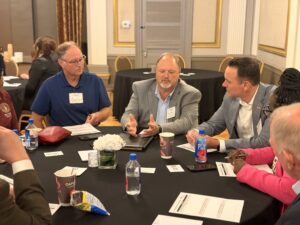
Full-time child care in the state averages $8,100 annually—nearly 14 percent of a typical family’s income. More than 30 percent of Missourians live in child care deserts, areas where the demand for care far exceeds supply. During small group discussions, legislators grappled with how these access gaps affect not just children’s development, but parents’ ability to work and contribute to the state’s economy.
“The data made it impossible to ignore,” said one legislator. “When families can’t access affordable child care, we’re limiting economic growth and leaving kids behind before they even reach kindergarten.”
Participants explored cost-modeling strategies from states like Michigan and New Mexico, which have worked to better align subsidy reimbursement rates with the actual cost of providing quality care. These models offer potential pathways for Missouri to sustain providers while expanding access to families across income levels and geographic areas.
Strengthening Missouri’s Teacher Pipeline
Missouri’s ongoing teacher shortage anchored the second major focus of the retreat. Legislators examined promising initiatives already underway, including the Grow Your Own Grant Program, which supports school districts in identifying and preparing future teachers from within their own communities—turning paraprofessionals, substitutes, and career-changers into licensed educators.
Hickman Mills School District Deputy Superintendent Casey Klapmeyer shared his district’s experience building these local pipelines, emphasizing that communities often have untapped teaching talent waiting for accessible pathways into the profession. Commissioner Eslinger highlighted Missouri’s strong mentorship network as another key asset: 97 percent of early-career teachers report having an assigned mentor, providing a foundation for improved retention.
The conversation also turned to compensation, working conditions, and the need for sustainable funding models that allow districts to compete for talent in a tight labor market. Legislators recognized that recruiting new teachers is only part of the equation—keeping experienced educators in classrooms requires systemic support.
Addressing AI in Education and Career Pathways
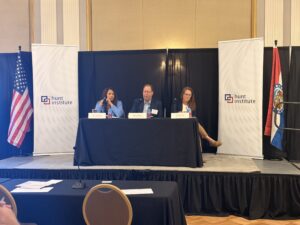
Missouri recently joined 28 states in releasing guidance for schools on artificial intelligence, and retreat participants considered how statewide frameworks can balance innovation with student privacy and data protection. The discussion emphasized the need for districts to have clear policies before deploying AI tools in classrooms, ensuring technology serves students rather than creating new risks.
The retreat also addressed how career and technical education, apprenticeships, and dual credit programs can strengthen Missouri’s talent pipeline. Legislators explored ways to reduce barriers to postsecondary completion while aligning high school coursework with regional workforce needs—connecting classroom learning to economic opportunity.
A Bipartisan Space for Shared Solutions
With 16 Democratic and 15 Republican legislators in attendance, the retreat reflected The Hunt Institute’s core model: creating nonpartisan spaces where policymakers can engage deeply with research, practitioners, and one another outside the pressures of the legislative session.
Launched in 2019 and modeled after Governor Jim Hunt’s original state retreat approach, the Missouri Legislators Retreat continues to provide a rare forum for substantive, cross-party collaboration on education policy. Post-retreat evaluations showed strong enthusiasm for the format, with multiple legislators requesting follow-up materials and expressing interest in continuing these conversations into the 2026 session.
Looking Ahead
The retreat underscored a growing commitment among Missouri lawmakers to address early childhood access and teacher workforce challenges with evidence-based strategies. In the coming months, The Hunt Institute will continue partnering with Missouri leaders as they identify policy opportunities that emerged from these discussions—turning two days of learning into legislation that supports students, families, and the state’s future workforce.
Click here to view the 2025 Missouri SLR Program Book
Click here to view the 2025 Missouri SLR Issue Brief
###
About The Hunt Institute
The Hunt Institute, an affiliate of the Duke University Sanford School of Public Policy, is a recognized leader in the movement to transform public education. Marshaling expertise from a nationwide partner network since its establishment in 2001, The Institute brings together people and resources that help build and nurture visionary leadership and mobilize strategic action for greater educational outcomes and student success. For more information, please visit: http://www.hunt-institute.org/