Explore The Hunt Institute’s education policy webinars designed for lawmakers, educators, school leaders, and families. Covering topics from career readiness and literacy to dual enrollment, expanded access, and voter priorities, our expert-led sessions offer actionable insights to improve education systems and student outcomes.
Stay informed and inspired—register for upcoming webinars or watch past events on our YouTube page.
Subscribe to our mailing list to receive updates on our upcoming webinars!
Wednesday, August 12 | 2 p.m. ET | 1 p.m. CT | 11 a.m. PT
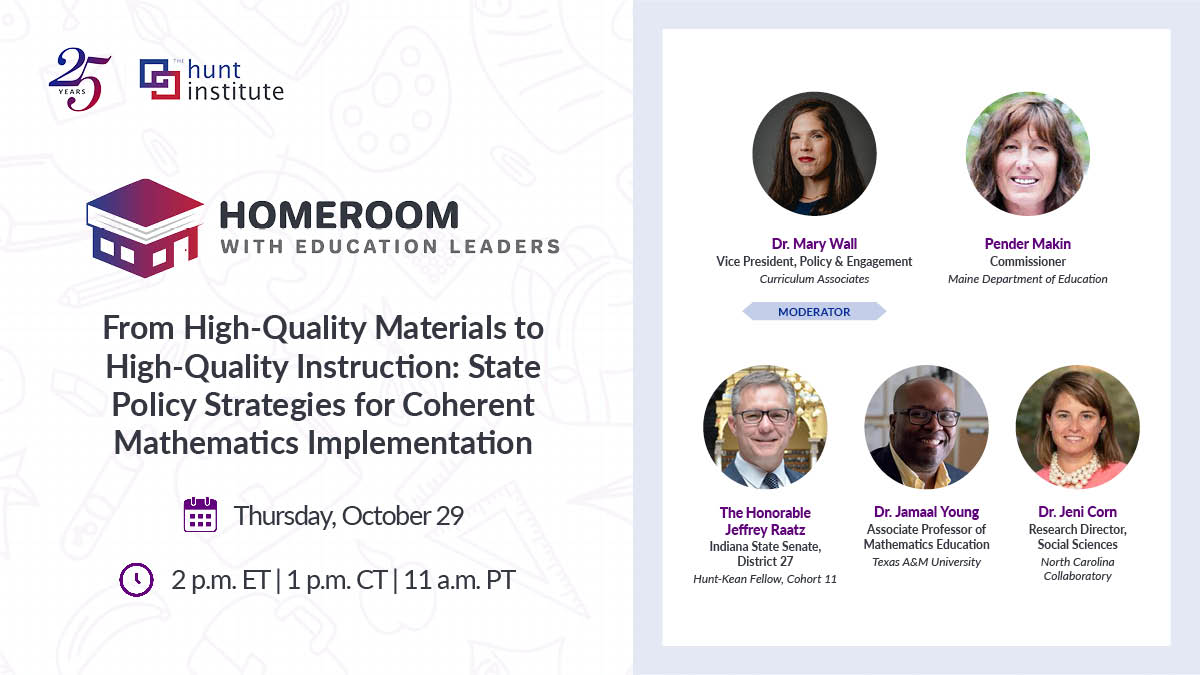
States across the country are rethinking how mathematics is taught, assessed, and supported, moving beyond compliance-driven approaches toward policies that meaningfully improve student outcomes. From revising standards and instructional materials to investing in teacher development and reexamining course pathways, leading states are aligning policy with the realities of classroom practice. This webinar will explore how states are “moving the needle” in math by connecting bold policy decisions with implementation strategies that support educators and expand access to rigorous, high-quality mathematics for all students. At the same time, while national attention in recent years has rightly focused on improving literacy outcomes, the data is clear that mathematics must be an equal priority. Results from the National Assessment of Educational Progress (NAEP) show that student performance in math remains a significant concern: twelfth-grade math scores in 2024 declined compared to both 2019 and earlier years, reaching the lowest levels since the assessment began, and gaps between higher- and lower-performing students have widened. Even where modest gains have emerged in earlier grades, progress has been uneven, with lower-performing students often not experiencing the same improvements as their peers. These trends underscore the need for sustained, coordinated attention to math teaching and learning alongside literacy efforts. Join The Hunt Institute for a conversation with state leaders, researchers, and practitioners who are driving this work forward. Panelists will share how their states are navigating key challenges, including balancing rigor and equity, supporting instructional coherence, and scaling effective practices across diverse districts. Participants will gain insight into what is working, where challenges remain, and how policy can serve as a lever for sustainable improvement in math teaching and learning.
Wednesday, September 9 | 2 p.m. ET | 1 p.m. CT | 11 a.m. PT
One of the most cost-effective ways to improve public safety and strengthen the workforce is through high-quality education and vocational training in correctional facilities. Participating in correctional education programs reduces an individual’s odds of returning to prison by 43%, with recidivism rates dropping even more dramatically as higher levels of education are completed. Research consistently shows that incarcerated individuals who participate in high-quality educational programming are significantly more likely to secure stable employment after release and far less likely to return to prison, saving taxpayers millions of dollars in reincarceration costs. However, for these programs to succeed, they must align with real-world job openings and high-demand industries. This session will examine how long-term educational and labor data can be used to build high-impact prison education and reentry initiatives.
This webinar will explore how state-level election outcomes influence the direction of education policy, from investments in teacher pay and workforce pipelines to priorities in literacy, mathematics, and college and career readiness. Panelists will examine how campaign issues translate into governing agendas, how ballot measures and legislative control shape policy implementation, and what education leaders should anticipate in the months following the election. Grounded in a bipartisan, nonpartisan lens, the conversation will elevate how states can move beyond political rhetoric to advance policies that improve student outcomes.