Recap: New Mexico Legislators Convene for 2026 Legislators Retreat on Education
May 28, 2026
The Hunt Institute convened New Mexico lawmakers from May 7-8, 2026 in Albuquerque, New Mexico, for a two-day, bipartisan retreat focused on strengthening education outcomes from early childhood through postsecondary and the workforce. The second annual New Mexico State Legislators Retreat’s co-chairs were Sen. Leo Jaramillo, Sen. Bill Soules, Rep. Brian Baca, and Rep. Joy Garratt. Albuquerque Mayor Tim Keller, a member of the Hunt-Kean Leadership Fellow Cohort 11, was also in attendance to welcome legislators to the Duke City along with special guest New Mexico Lieutenant Governor Howie Morales.
The Hunt Institute’s Board of Directors was represented at the Retreat, as we were honored to have former New Mexico Governor Susana Martinez, Vice Chair of The Institute’s Board of Directors, and former Massachusetts Governor Jane Swift join the convening.
The Retreat provided an opportunity for members from both parties to step away from Roundhouse pressures and engage in evidence-informed conversations about the state’s education priorities. Through panels, perspectives, and facilitated discussions, participants examined what it will take to accelerate student learning, support educators, and strengthen pathways to college and career.
Universal Child Care Accessibility Headlines the Retreat
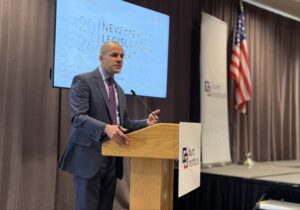
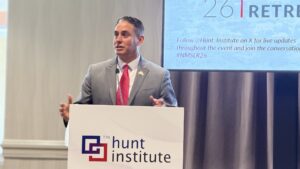
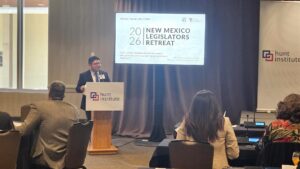
Day 1 of the Retreat began with welcome and opening remarks from Dr. Javaid Siddiqi, President & CEO, The Hunt Institute, New Mexico Lt. Governor Howie Morales, Hunt-Kean Leadership Fellow Cohort 6, and Lorenzo Pedro, Director of State Engagement, The Hunt Institute.
The programming started with the “From Assistance to Universal Access: New Mexico’s Child Care System in Transition” session, a discussion on how New Mexico’s expanded access to early childhood education and care, including no-cost child care and Pre-K, is unfolding across communities statewide. The session explored what “universal” access looks like in practice for families and providers, including capacity and availability across regions and age groups, access in rural and tribal areas, workforce and facility constraints. Legislators further examined how the state can define and maintain quality as enrollment expands. Jovanna Archuleta, Early Childhood Education Program Director, LANL Foundation, moderated the conversation with resource experts Yesenia Robles-Brown, Chief of Staff, National Association for Family Child Care, and Gabrielle Uballez, Executive Director, New Mexico Voices for Children.


Strengthening New Mexico’s Special Education Teacher Pipeline
States across the country continue to face persistent challenges in recruiting and retaining a sufficient number of qualified special education (SPED) teachers. These shortages are particularly pronounced in rural, frontier, and Tribal communities, where smaller districts face persistent recruitment barriers, limited access to preparation programs, and fewer support structures for new teachers. According to the 2024–2025 New Mexico Educator Vacancy Report, special education accounts for approximately 36 percent of all teacher vacancies statewide, a level that has remained persistent year over year.
Tim Bedeaux, K-12 Education Policy Officer, Thornburg Foundation guided the conversation with legislators and resource experts, Dr. Amy Stevens, Senior Director of Professional Development and Standards, Council for Exceptional Children, and Deputy Secretary Jill Vice, Office of Special Education, New Mexico Public Education Department. The panel highlighted how preparation pathways, licensure routes, and higher education partnerships can influence workforce capacity, especially in rural, frontier, and tribal communities where access to qualified personnel can be constrained. As New Mexico continues working to meet student service needs and address educator shortages, legislators were able to examine strategies to strengthen the special education teacher pipeline.


Perspectives from New Mexico’s K-12 Educators
During the afternoon, policymakers moved into small-group discussions with school leaders and teachers from across New Mexico, including Lorilei Chavez, 2025 New Mexico Teacher of the Year from Bernalillo High School, to better understand how state policy translates into day-to-day practice in communities where geography, staffing, and access can shape student experiences. Conversations focused on student access, instructional quality, service delivery, and opportunities to strengthen outcomes across transitions and systems.


An Evening Discussing AI
Day One of the Retreat concluded with an exciting reception and dinner program, titled “Preparing Students for an AI-Driven Future” that touched on how AI and emerging technologies are reshaping the workforce, and what that means for education systems from K–12 through higher education. Dr. Javaid Siddiqi, President & CEO, The Hunt Institute and former New Mexico Governor Susana Martinez, Vice Chair, The Hunt Institute Board of Directors welcomed the audience and spoke about the Institute’s commitment to bipartisanship and how Governor Hunt’s legacy continues to guide the work being done in New Mexico.
Resource experts included Claus von Zastrow, Senior Policy Director, Education Commission of the States, Brian Gonzalez, Applied AI and Workforce Strategist, FutureWise Strategies, and Dr. Kim Lanoy-Sandoval, Executive Director, Future Focused Education who discussed responsible AI use in education, student skill development, ethics, data privacy, and instructional quality, as well as the implications for rural communities navigating broadband and infrastructure gaps.


Career Pathways and Funding in Focus
The next morning, legislators jumped into a session that examined how Career and Technical Education (CTE) pathways can prepare students for postsecondary education and the workforce while reducing the cost and time to credential. CTE is increasingly central to how states prepare students for both postsecondary education and the workforce. In New Mexico, this role is particularly important given the state’s economic priorities, diversity, and the need to expand access to high-quality career pathways across both urban and rural communities.
Retreat Co-Chair Rep. Joy Garratt (New Mexico House of Representatives, District 29) set the stage for research experts: The Honorable Jane Swift, former Governor of Massachusetts and CEO, Education at Work, and member of The Hunt Institute Board of Directors, Craig Walker, Regional Vice President, State Solutions, Curriculum Associates, Breezy Gutierrez, Senior Manager, College and Career Readiness Bureau, New Mexico Public Education Department, and The Honorable JB Holston, Executive Director, Colorado Department of Higher Education. The panel explored access and capacity challenges, particularly in rural districts and smaller schools, and how to support smooth transitions for students after graduation.


“Aligning career and technical pathways gives students real options and strengthens New Mexico’s workforce. I appreciate that both Republicans and Democrats came together to focus on what works and advance practical solutions that expand opportunity statewide,” said Retreat Co-Chair, Representative Joy Garratt – NM House, District 29 (Bernalillo County).
Examining Education Funding and the Permanent Fund
Legislators then transitioned to a session exploring how education dollars are allocated and whether current investments are delivering results for students. New Mexico’s education funding landscape is uniquely shaped by the Land Grant Permanent Fund (LGPF), which was established at statehood in 1912. The LGPF provides a predictable annual distribution independent of short-term revenue fluctuations and helps buffer public schools and universities from volatility tied to oil and gas markets or economic downturns.
Retreat Co-Chair Sen. Bill Soules (New Mexico Senate, District 37) provided level-setting opening remarks for a panel discussion moderated by Dr. Melody Schopp, Vice President of Government Relations, MetaMetrics, with resource experts Dr. Jesse Levin, Principal Research Economist, American Institutes for Research, and Hope Morales, Executive Director, Teach Plus New Mexico. They offered perspectives on where funding is working, where adjustments may be needed, and how future budget decisions can balance effectiveness, efficiency, and long-term sustainability.


“Regardless of party, we all share a responsibility to ensure education dollars and priorities are improving outcomes for kids. This retreat allowed us to focus on the data, ask hard questions, and find practical, bipartisan paths forward,” said Retreat Co-Chair, Senator Bill Soules – NM Senate District 37 (Doña Ana County).
The Road Ahead for New Mexico’s Education System
The Retreat came to a close with policy reflections and planning roundtables, facilitated by Jarvis Lundy, Director of Policy, The Hunt Institute. Legislators identified their education priorities and policy goals while reflecting on collaborative next steps that can move New Mexico forward in education.


The Hunt Institute is grateful to the Retreat Co-Chairs Sen. Leo Jaramillo, Sen. Bill Soules, Rep. Brian Baca, and Rep. Joy Garratt, New Mexico legislative leaders, resource experts, and educators who contributed their time and expertise. A special thank you to our funders, The Bezos Family Foundation and The Saul Zaentz Charitable Foundation for supporting The New Mexico Retreat and making the programming possible.