What NAEP Scores Miss About College and Workforce Readiness
October 6, 2025
NAEP scores often make headlines, but they don’t tell the whole story. It’s time to rethink what student readiness really means and how we measure it.
Authors: Javaid Siddiqi, Ph.D., Kathleen E. Arney, M.Ed., and Sarah Lewisohn
National Assessment for Educational Progress (NAEP) scores are often used as a benchmark of student success, but they do not always reflect the full picture of workforce or college readiness, or even what local communities truly value in K-12 education.
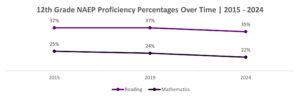
In 2024, 12th graders hit new lows according to NAEP, but the scores are not so different from where they were 10 years ago. While this decline is certainly cause for concern, this data may not show the full picture of student preparation.
This moment should spark a larger conversation about how we define proficiency, and whether NAEP captures the skills students need to thrive in college, career, and life.
Parents have been raising concerns about schools not teaching “real skills” for the future workforce and 69 percent favor increasing job skills and workforce training opportunities in high school, like internship opportunities and apprenticeships. Prioritizing real-world skills is widely popular amongst parents, with 70 percent agreeing it is a very important issue. NAEP measurements of student achievement do not focus solely on the skills parents deem most important for students to learn, such as problem-solving, communication, and critical thinking.
NAEP and Workforce Readiness
For students planning to enter the workforce immediately after high school completion, NAEP scores may not offer information that is most reflective of these goals. While proficiency in NAEP measures important skills like defending ideas and giving supporting examples for a mathematical conclusion, it also includes solving algebraic operations with polynomials, a skill that is not used consistently across industries.
States receive federal grants supporting Career and Technical Education, CTE, through the Strengthening Career and Technical Education for the 21st Century Act or Perkins V, which provides over $1.5 billion annually. While this investment is significant, the program needs an additional 15 percent investment to maintain current services with inflation.

State leaders are re-evaluating measures for student readiness. Increasingly, states are removing graduation tests in favor of multiple graduation pathways with options like dual enrollment, early college, work-based learning, CTE, or International Baccalaureate programs. Students may select one of these pathways to pursue a diploma, allowing them to tailor their education to their long-term aspirations.
States like Colorado, Florida, South Carolina, and more offer a career-focused pathway for graduation. These programs include Jump Start in Louisiana, which allows students to earn a state-approved industry credential in welding, carpentry, or health services. Colorado has an option for districts to satisfy diploma requirements through a Teacher Recruitment, Education, and Preparation Program. This option allows high school students to participate in their local educator pathway and be eligible to receive tuition-free education.
While concerns about literacy or mathematics remain, students can choose their own measures of success that fit the future they see for themselves. Ultimately empowering students to jump start their choice-filled lives during their educational journey rather than waiting until they enter the workforce or postsecondary education.
NAEP and College Readiness
According to NAEP, 54 percent of 12th graders were admitted into 4–year colleges or universities, but only 35 percent of 12th graders were considered academically prepared for college. In this respect, NAEP scores are useful, but limited.
This stark disconnect between who high schools, colleges, and NAEP scores deem ready for postsecondary education should give leaders pause about how we are defining readiness and encourage a closer look into ensuring local systems are available to measure what matters to a given community.

It is important to note that NAEP scores are proven to be a reliable measure of college readiness, with higher scores correlating with better grades. However, colleges are open to accepting students who do not perfectly meet academic criteria. For example, many institutions of higher education (IHEs) use a holistic approach to review applications, meaning they accept a range of data points to create a clear picture of a student and give opportunities to explain poor test scores or variation in academic performance.
As national measures of student achievement continue to be challenged on a federal level, it is important local communities invest in their own data systems to maintain a clear picture of how students are performing. IHEs are a potential ally for K-12 leaders who are looking for support in developing strong data systems. Not only do IHEs offer technical expertise, but they are also one of the key indicators tracking student readiness in communities already. Several public universities and community colleges partner with high schools to provide mentorship or direct learning experience to support student readiness. Education leaders should leverage the existing resources in their communities.

Policy Considerations
NAEP scores offer one important piece of the puzzle, but they cannot tell us the full story of whether students are ready for what comes next. Leaders should use NAEP alongside other data sources to strengthen or build systems that reflect local definitions of readiness.
In some places this may emphasize workforce skills that are aligned to industry demands, in others this may mean college persistence or strengthening academic foundations. By centering local data, leaders can ensure not only student success, but that measurements for school success are reflective of what truly matters.
As experts dive into these questions, it is important to keep these considerations in mind:
Redesigning High School for Real-World Learning
High school redesign is a growing area in K-12 education. More schools and districts are questioning the factory-based model of education and seeking alternatives that center students’ needs and address concerns about student performance and readiness. Persistent absenteeism, 31 percent of 12th graders are missing three or more days a month, and rising concerns about literacy show that traditional models are not meeting student needs across the board.
Some examples of innovative redesign include:
- Noble High School in rural Maine is implementing small learning academies that serve three towns and use a system of learning based on proficiency and demonstrated learning rather than traditional grades.
- Hampton City Schools in Virginia implements 16 career academies and 44 career pathways across the four high schools in the district.
- The Science and Math Institute in Tacoma Washington is one of three high schools in the area that makes their STEM partnership applicable through a partnership with the local zoo.
These approaches give students more relevant, engaging experiences while equipping them with skills for life after graduation.
Aligning Education and Access to Opportunity
As proficiency rates creep lower, achievement gaps continue to widen across race, English Learner status, and for students with disabilities. In Grade 12 math, NAEP found that the achievement gap between the highest- and lowest-performing students was larger in 2024 than in all prior assessments.
This matters because it further demonstrates that opportunity for learning is not distributed equitably. For example, remediation programs in higher education – intended to close gaps – often leave low-income students and students of color behind, forcing them into non-credit bearing classes and increasing the cost of higher education. More effective models, such as co-requisite supports including tutoring alongside credit bearing courses, have shown greater success in closing equity gaps and helping students pass entry-level sources.
If states want to align K-12 outcomes with workforce and college needs, they must keep equity at the center of data collection and design efforts. Every student, regardless of zip code or background, should have access to rigorous academics, real-world learning and skills and pathways that reflect their goals.
Building Better Data Systems for Student Readiness
Redesigning how we measure readiness requires collaboration across sectors. NAEP data should be complemented by local measures, reflecting input from:
- K-12 leaders and educators who see daily student progress and challenges
- Parents and students, who are clear about wanting real-world, transferable skills
- Higher education institutions, who already review students holistically and can provide insight into persistence and completion trends
- Industry and community partners, who can shape workforce pathways
Partnerships like College Board’s Career Kickstart program, which expands AP courses to offer industry credentials in fields like personal finance and cyber security offer a blueprint for how K-12, IHEs, and employers can work together. Similarly, large data projects like Arizona State University’s Helios Decision Center for Educational Excellence offers insight into workforce pipelines and long-term industry demands that can help prepare students for in-demand industries.
NAEP highlights the importance of equity gaps and academic challenges, but it cannot capture all aspects of readiness that communities value. By building stronger, more inclusive data systems, and involving the right partners, leaders can ensure students are measured not just by test scores, but by the skills, knowledge and opportunities that matter most for their futures.
Need Education Research or Technical, Unbiased Support? We’re Here to Help
The Hunt Institute is particularly skilled in offering technical assistance and gathering input from community stakeholders to develop community-informed recommendations. Our listening tours have informed the work of the North Dakota Teacher Retention and Recruitment Task Force as well as the Virginia Department of Education’s efforts to redesign their state accountability system. The Hunt Institute sits at the intersection of policy, research, and practice. It takes a village to support our students. Only together can we make our school systems the best places for our students to learn and grow.