A Call for Education Champions
Authors: Jaalil Hart, Ph.D., Director of K-12 and Javaid Siddiqi, Ph.D., President and CEO
The 2026 Across the Aisle Poll delivers a clear message from parents and voters: public education must be a priority for elected leaders. Nearly 9 in 10 voters across the political spectrum believe officials should take stronger, more explicit action to strengthen the education system. This is not simply a preference, it is a mandate from constituents calling for leadership, clarity, and sustained commitment.
Governor Jim Hunt offered a powerful model of what it means to be an education champion. From elevating teacher voices in policymaking to launching Smart Start, and expanding access to high-quality early childhood education, his leadership demonstrated how bold, bipartisan action can shape generations of opportunity. Today, voters are once again asking leaders to step forward. The question is simple: how will you champion education in your community?
The Findings
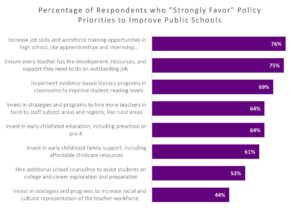
The most strongly favored policy priorities include strengthening the P-20 education system to expand access to pre-K programs, support educators, improve student literacy, and prepare the next generation of leaders for the workforce. Notably, these priorities transcend partisan divisions—they represent common ground where meaningful progress is possible.
Expanding Access to Early Learning
Eighty-one percent of parents and voters identify expanding pre-K and early childhood education as an important priority, placing it among the top issues in the 2026 Across the Aisle poll. This broad support reflects a shared understanding of early learning’s transformation potential—and presents a clear opportunity for policymakers. In a deeply divided political climate, early childhood education remains an area where leaders can build coalitions and deliver results that families across the spectrum want to see.
“The biggest benefit of pre-K is that it levels the playing field. There is much research about the level of learning and development that children begin school with as it relates to the socioeconomic status of their family and the education of their parents.” – Woman, Independent, White (Teacher)
Research reinforces this perspective, showing that children who participate in high-quality early childhood programs enter kindergarten with stronger literacy, numeracy, and social-emotional skills—foundations that support long-term success in school and beyond.
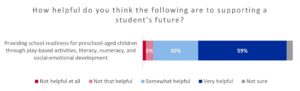
The benefits extend well past kindergarten readiness. Studies estimate a return on investment of $7 to $12 for every dollar invested in preschool, with long-term gains including reduced opportunity gaps, higher graduation rates, stronger economic stability, and improved health outcomes. For policymakers weighing competing budget priorities, few investments offer this level of sustained, measurable impact. Early childhood education is not only a social good—it is a strategic investment in workforce development, economic growth, and long-term community well-being.
Supporting Student Literacy
Ninety-two percent of parents and voters agree that addressing students not reading at grade level is an important issue. This near-universal consensus cuts across every demographic and political line, signaling that literacy is not just a priority, but an urgent mandate from constituents. For elected officials, this represents both a clear directive and a significant opportunity: investments in literacy instruction draw stronger public support than virtually any other education policy.
The urgency is reinforced by sobering data. In 2024, only 60 percent of fourth graders read at or above a basic level on the National Assessment of Educational Progress, and students who fall behind by the end of the fourth grade are between 80 and 90 percent likely to remain struggling readers. Evidence-based literacy instruction and intervention offer one of the most powerful opportunities to change life trajectories, disrupt inequity, and strengthen long-term economic mobility.
To date, 42 states and the District of Columbia have enacted evidence-based literacy legislation. The science of reading has provided policymakers with a clear roadmap—but the question is no longer whether we know what works. The challenge now is whether states will follow through, ensuring that policy translates into classroom practice through sustained leadership, educator support, and a continued focus on what happens inside schools every day.
Hiring Quality Teachers
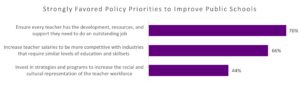
The 2026 poll shows overwhelming support for hiring quality teachers, with 93 percent agreement—the highest priority across all education issues. The message to policymakers is clear: voters see teacher quality as the foundation for every other education reform. Parents and voters also strongly support ensuring educators are well-trained and well-resourced to meet the needs of all students, regardless of background or zip code. This commitment extends to representation as well, with 80 percent of parents saying students thrive when classrooms reflect the world around them—reinforcing research that diverse educators strengthen both academic and social outcomes. Together, these findings point to a clear mandate: investing in a strong, well-supported, and diverse teacher workforce is essential to delivering the education system families expect.
Credentials of Value
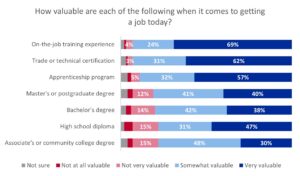
As views on postsecondary attainment evolve, parents and voters increasingly recognize both college degrees and industry-recognized certifications as meaningful credentials of value. This shift reflects a growing understanding that economic mobility and workforce success can follow multiple pathways.
North Carolina’s statewide attainment goal reflects this change, calling for 2 million residents ages 25 to 44 to hold a postsecondary degree or industry-valued credential by 2030. The EleveateNC program supports this work by bringing together leaders from across the state to collaborate and develop locally driven action plans. Through these efforts, cohort members have strengthened transfer pathways, expanded access for justice-involved youth, and integrated career exploration—such as internships and apprenticeships—into community strategies. Together, this work underscores that attainment goals are most effective when credentials are clearly connected to opportunity.
Fellows Answering the Call
The 2026 Across the Aisle poll sends a clear message to education leaders: voters want action to strengthen the public education system. Even amid increasing polarization, families across the country agree that public education remains a shared priority. For 25 years, The Hunt Institute has supported bipartisan leadership through programs including Hunt-Kean, Hunt Mayors, and Hunt State Policy Leadership Fellowships. These leaders are translating policy into action—from statewide investments in educator training to local efforts that integrate childcare and strengthen early literacy. As the 2026 midterms approach, education stands out as a defining issue. Governor Hunt’s legacy reminds us that progress comes from leaders who listen, build coalitions, and act on behalf of students and communities. At this moment of opportunity, voters are calling for education champions to step forward.